If you’re deciding between Signal and Telegram for secure messaging, here’s the bottom line: Signal is the better choice for privacy and security, while Telegram offers more features but compromises on privacy in many areas.
- Signal: Prioritizes privacy with default end-to-end encryption for all chats, minimal data collection, and open-source transparency. Ideal for sensitive conversations like those of journalists, activists, or anyone needing strong confidentiality.
- Telegram: Focuses on features like large group chats and cloud syncing but lacks default end-to-end encryption for most chats. Secret Chats are encrypted but must be enabled manually and don’t work across devices.
Quick Comparison:
| Feature | Signal | Telegram |
|---|---|---|
| Default Encryption | End-to-end encryption (all chats) | Client-server encryption (most chats) |
| Open-Source Transparency | Fully open-source | Partially open-source |
| Data Collection | Minimal | Collects metadata and stores messages |
| Group Chat Encryption | Yes | No |
| Usability Across Devices | Yes | Limited for Secret Chats |
For privacy-first communication, Signal is the safer option. Use Telegram for casual conversations or large groups where advanced features matter more than absolute security.
Signal vs Telegram 2026: Which Messaging App is Safer?
Encryption Methods: Signal vs Telegram
The way these two apps handle encryption highlights their differing priorities when it comes to securing your messages. Signal treats encryption as a core principle, applying it universally, while Telegram offers strong end-to-end encryption only in its Secret Chats, leaving most messages protected by client-to-server encryption instead.
Signal’s End-to-End Encryption
Signal employs the Signal Protocol, an open-source system that automatically encrypts every message, voice call, and video call – including group chats – without requiring any extra effort from users. When you send a message, it gets encrypted on your device, travels as scrambled data, and is only decrypted on the recipient’s device. This means Signal’s servers never have access to the actual content of your messages.
Because the Signal Protocol is open-source, independent security experts can review and audit the code. This transparency builds trust and ensures that any potential vulnerabilities can be identified and addressed.
Telegram’s MTProto Protocol
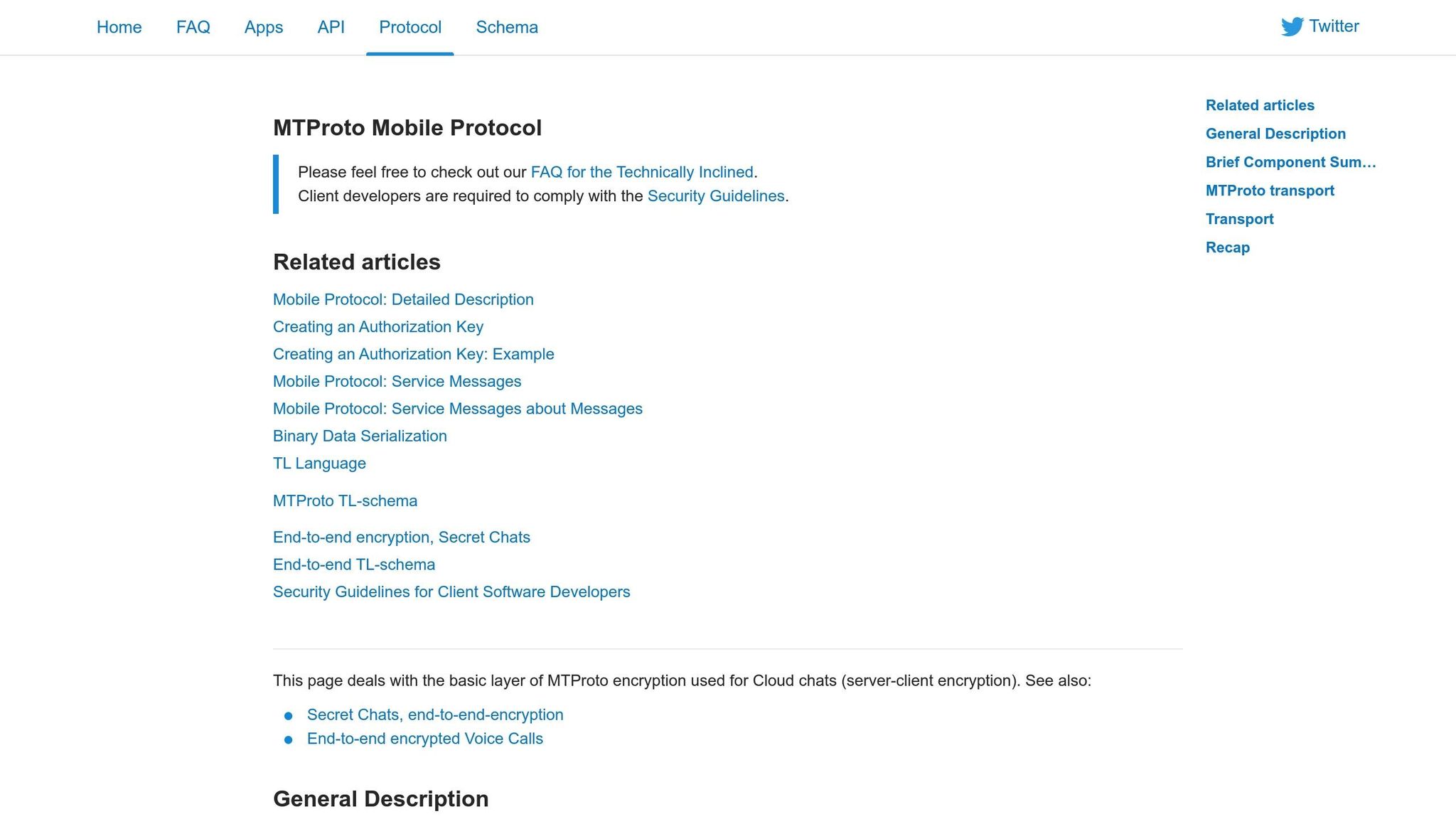
Telegram takes a different approach with its proprietary MTProto protocol. Regular chats on Telegram are encrypted client-to-server, which allows for convenient cloud syncing across devices. However, this also means Telegram’s servers can access the content of these messages. For full end-to-end encryption, users must enable Secret Chats, which are limited to one-on-one conversations and tied to specific devices.
This setup supports Telegram’s cloud-based features, like syncing message history across multiple devices, but it comes at the expense of privacy for regular chats. Additionally, since the MTProto protocol is proprietary, it is harder for independent researchers to verify its security. This lack of transparency has led to skepticism among some experts about Telegram’s reliance on its own encryption system.
For users who face higher risks, such as journalists or activists, Signal’s default end-to-end encryption and minimal data collection make it a safer choice for maintaining privacy. In contrast, Telegram’s server-side storage and optional encryption for Secret Chats may not offer the same level of security for sensitive communications.
Encryption Features Comparison
| Feature | Signal | Telegram |
|---|---|---|
| Encryption Protocol | Signal Protocol (Open Source) | MTProto (Proprietary) |
| Default E2EE for All Chats | Yes | No (Only for Secret Chats) |
| Group Chat E2EE | Yes | No |
| Open-Source Code | Yes | Partial (Apps only) |
| Independent Audits | Yes | Limited |
| Server Access to Messages | No | Yes (for regular chats) |
This comparison sets the foundation for examining each app’s data collection practices in the following section.
Privacy Policies: Data Collection Practices
When it comes to privacy, the type and amount of data an app collects play a huge role in determining its overall security. Signal and Telegram follow drastically different paths in this regard – one barely collects any data, while the other gathers a fair bit to support its cloud-based features. Let’s dive into how their privacy policies influence their data handling practices.
Signal’s Data Collection
Signal is built around the idea of collecting as little data as possible. To create an account, all you need is a phone number. That’s it. The app doesn’t store your contact lists in a readable format either. Instead, it uses a privacy-first contact discovery system, ensuring it never actually sees who’s in your address book.
Signal also avoids logging metadata that could reveal your communication habits. It doesn’t track who you message, when you message them, or even your IP address. Features like “sealed sender” ensure that even Signal’s servers don’t know who sent a message.
When U.S. law enforcement agencies have requested user data from Signal, the company has been able to provide little more than confirmation that a phone number is linked to an account and the last time it connected. This isn’t because Signal refuses to cooperate with valid legal requests – it’s simply because the data doesn’t exist on their servers.
Messages and media are encrypted end-to-end and temporarily stored on Signal’s servers only if the recipient is offline. Once delivered, the content is immediately deleted. Even if someone managed to breach Signal’s servers, they wouldn’t find any conversation histories or attachments.
As for payments, any financial transactions for donations or subscriptions are handled by third-party providers. This keeps your payment information entirely separate from Signal’s messaging platform.
Telegram’s Data Collection
Telegram, on the other hand, collects a lot more user information. It gathers your phone number, profile name, profile photo, and synced contact list. It also logs details like IP addresses, device type, and app version.
This extensive data collection supports Telegram’s convenience-driven features, such as seamless syncing across devices, cloud backups of your chat history, and the ability to access old messages from any device. However, these perks come with a trade-off in privacy.
Regular one-on-one and group chats in Telegram are stored in the cloud, and the company’s infrastructure has access to unencrypted message content. Additionally, Telegram retains metadata like timestamps and IP logs, which could be accessed during legal investigations or security incidents.
Things change when you use Telegram’s Secret Chats. These chats are protected by end-to-end encryption and are not stored in Telegram’s cloud, giving you more privacy. However, most users don’t enable Secret Chats, leaving their conversations more vulnerable.
Telegram’s privacy policy also allows it to share data like IP addresses, phone numbers, and stored messages when legally required. This approach is a stark contrast to Signal’s minimal-data design.
Privacy Policies Comparison
Here’s a quick look at how the two apps compare in their data collection practices:
| Data Category | Signal | Telegram |
|---|---|---|
| Account Identifier | Phone number only | Phone number, profile name, profile photo |
| Contact Lists | Privacy-focused discovery | Synced and stored on servers |
| Message Content | Never stored (end-to-end encrypted) | Stored in cloud for regular chats; not stored for Secret Chats |
| Metadata | Minimal retention, sealed sender hides patterns | Collected and retained |
| Device Information | Briefly processed, not retained long-term | Collected (device type, app version) |
| Server Access to Messages | No access to any message content | Full access to regular chat content |
| User Control | Disappearing messages, remote deletion, registration lock | Secret Chats for sensitive topics, profile visibility settings |
| Legal Data Requests | Can only provide phone number and last connection time | Can provide IP addresses, phone numbers, and cloud-stored messages |
For U.S.-based journalists, lawyers, activists, or anyone dealing with highly sensitive information, Signal’s minimal data collection makes it the safer option. Privacy experts often emphasize that Signal’s design leaves very little data to exploit, whether through legal requests, server breaches, or unauthorized access.
Telegram’s popularity among activist groups can sometimes create a false sense of security. Unless users specifically enable Secret Chats, their conversations lack end-to-end encryption and are stored on Telegram’s servers.
For those concerned about network-level tracking, pairing your messaging app with a reliable VPN can add another layer of protection by masking your IP address. Resources like Cloud Explorer provide reviews of top VPN services – such as NordVPN, Surfshark, IPVanish, ExpressVPN, Private Internet Access, and CyberGhost – helping U.S. users choose a VPN that complements their privacy needs.
To further limit your data exposure, tweak the privacy settings on your app. In Signal, enable registration lock PINs, use disappearing messages for sensitive conversations, and keep your profile information minimal. On Telegram, opt for Secret Chats when discussing private matters, limit who can view your phone number and profile photo, and carefully manage contact synchronization permissions.
sbb-itb-e1a0769
Security Features: What Each App Offers
When it comes to everyday use, the security features baked into messaging apps are just as important as their encryption and privacy policies. Signal and Telegram have taken very different paths here – Signal prioritizes strong, built-in protections by default, while Telegram offers optional tools for users who want extra security. These features adapt to different needs, building on the encryption and privacy practices we covered earlier.
Signal’s Security Features
Signal ensures all your conversations are end-to-end encrypted right out of the box – no setup required. This includes group chats, with Signal’s servers handling group membership without exposing any metadata. This makes Signal a solid choice for private discussions, whether they’re with family or colleagues.
Beyond encryption, Signal offers disappearing messages with timers ranging from 30 seconds to four weeks. Once the timer runs out, the messages vanish from both devices. It also includes a view-once media feature, allowing recipients to view a photo or video just one time. On Android, Signal takes it a step further by blocking screenshots of this media. Another standout feature is sealed sender, which hides the sender’s identity – even from Signal’s own servers.
For account security, Signal includes a registration lock PIN to prevent unauthorized re-registration of your number. It also supports screen locks with biometric authentication (like Face ID or fingerprints) or a PIN for added protection.
Telegram’s Security Features
Telegram offers a mix of account and message-level security options, but its default chats use client–server encryption rather than end-to-end encryption. For users seeking more privacy, there’s the Secret Chats feature. Secret Chats include self-destruct timers ranging from one second to one week. However, these chats are device-specific, meaning they can’t be accessed on multiple devices, and they’re not available for group conversations.
Telegram excels in large-scale communication, with supergroups that can host up to 200,000 members and public channels that can reach unlimited audiences. These tools are popular for activism, political organizing, and interest-based communities. However, they rely on server-side storage without end-to-end encryption, making them more like semi-public platforms than truly private messaging spaces.
To secure your account, Telegram offers two-step verification with a password. It also lets users customize privacy settings, controlling who can see their phone number, profile photo, and last-seen status.
Security Features Comparison
| Security Feature | Signal | Telegram |
|---|---|---|
| Disappearing messages | Available for all chats; timers from 30 seconds to 4 weeks | Only in Secret Chats; timers from 1 second to 1 week |
| View-once media | Yes, with screenshot blocking on Android | Not available |
| Screenshot blocking | Yes, for view-once media on Android | Not available |
| Sealed sender | Yes, hides sender identity from servers | No |
| Registration lock | Registration lock PIN | Two-step verification with password |
| Screen lock | Biometric or PIN | Passcode lock |
| Large groups & channels | Supports smaller, private groups with E2EE | Supports supergroups up to ~200,000 members and public channels without E2EE |
| Multi-device Secret Chats | Not applicable (all chats are E2EE) | No, Secret Chats are device-specific |
For users who prioritize confidentiality in family or work conversations, Signal’s automatic end-to-end encryption makes it the safer choice. On the other hand, Telegram shines for large-scale communities or public groups where visibility and scale matter more than complete privacy. That said, it’s worth noting that Telegram’s proprietary MTProto protocol hasn’t undergone the same level of independent cryptographic review as Signal’s widely trusted Signal Protocol. This could be a critical factor for journalists, activists, or anyone operating in high-risk environments.
Transparency and Security Audits
When you entrust a messaging app with your private conversations, transparency plays a crucial role. Security claims mean little if they can’t be verified. Signal and Telegram approach transparency in fundamentally different ways, and these differences directly impact how much you can trust each platform. Let’s break down how their transparency practices influence their security credibility.
Signal’s Open-Source Code
Signal operates with complete transparency. Every piece of its code – from the mobile apps to desktop clients and even its server software – is publicly available on GitHub. This openness allows anyone with technical expertise to inspect how the app works, verify its encryption methods, and identify any potential vulnerabilities.
But Signal doesn’t stop at code availability. The platform regularly undergoes third-party security audits conducted by independent experts. These audits consistently validate Signal’s encryption and metadata protection, reinforcing its reputation as a secure messaging app. In fact, the Signal Protocol is often referred to as the “gold standard” for end-to-end encryption. Even WhatsApp relies on the Signal Protocol for its encryption, a clear sign of its reliability and trustworthiness.
When vulnerabilities are identified, Signal’s open-source framework ensures they can be addressed quickly, with the broader community able to verify the fixes.
Telegram’s Transparency Shortcomings
Telegram, on the other hand, adopts a partially open-source approach. While the client-side code – the software you install on your devices – is open for inspection, the server-side code remains proprietary and closed. This is significant because Telegram stores most messages on its servers (unless you use Secret Chats). Without access to the server code, independent verification of Telegram’s full security infrastructure is impossible.
Telegram’s custom encryption protocol, MTProto, has also faced scrutiny. Unlike Signal’s protocol, MTProto has not undergone extensive peer review. Cryptography experts have questioned its reliability, with some arguing that Telegram should have used established encryption standards instead of creating its own.
While Telegram has conducted some security audits, these have been limited in scope and frequency compared to Signal’s ongoing efforts. Additionally, Telegram does not regularly publish transparency reports detailing government or law enforcement data requests. For U.S. users concerned about surveillance, this lack of transparency raises questions about how data might be accessed.
This opacity creates practical risks, especially for individuals like journalists or activists handling sensitive information. With Telegram’s reliance on cloud storage and the inability to fully verify its server-side security practices, users must rely on the company’s assurances – a level of trust that might not be sufficient for everyone.
Transparency Comparison
| Transparency Feature | Signal | Telegram |
|---|---|---|
| Client app code | Fully open-source (iOS, Android, desktop) | Open-source |
| Server code | Fully open-source | Proprietary, closed-source |
| Encryption protocol | Signal Protocol (widely reviewed) | MTProto (limited review) |
| Third-party security audits | Regular and thorough audits | Limited audits |
| Protocol adoption by others | Used by platforms like WhatsApp | Exclusive to Telegram |
| Vulnerability disclosure | Transparent, rapid fixes | Less transparent |
| Transparency reports | Regularly published | Rare or infrequent |
| Independent verification | Fully verifiable | Only partially verifiable |
These differences make Signal the go-to choice for journalists, activists, and privacy advocates who demand the highest level of security. When your safety depends on secure communications, the ability to independently verify security claims becomes critical.
For added protection, consider pairing a secure messaging app like Signal with a reliable VPN. While a VPN hides your online activity from your ISP, it can’t compensate for a messaging app with opaque security practices. For VPN recommendations, check out Cloud Explorer.
For U.S.-based users seeking the most reliable security, Signal’s transparency and minimal data collection align perfectly with broader privacy best practices. With Telegram, however, you’re placing more trust in the company’s reputation than in verifiable proof – a distinction that matters when privacy is non-negotiable.
Conclusion: Which App Should You Choose?
The best app for you depends on what matters most. If privacy and security are non-negotiable, Signal is the better option. It encrypts all messages by default, collects minimal data, and is fully transparent thanks to its open-source code. For journalists, activists, or anyone dealing with sensitive information, Signal’s security features make it a safer bet.
On the other hand, Telegram focuses on cloud-based functionality, making it perfect for large group chats, file sharing, and social interactions. However, this convenience comes with compromises. Most chats aren’t encrypted end-to-end unless you activate Secret Chats, and your messages are stored on servers you can’t personally verify.
Signal is the go-to app when privacy is your top concern. It’s built for secure, private conversations – whether one-on-one or in small groups where confidentiality is key. Telegram, however, shines in casual settings, community building, and scenarios where syncing across multiple devices is more important than airtight security.
For U.S. users worried about government surveillance or data breaches, Signal’s minimal data collection means there’s less information available to hand over if authorities come calling. Telegram’s reliance on cloud storage and its closed server code means you’ll need to trust the company’s assurances rather than independently verified proof.
You don’t have to choose just one app. Signal can handle your private, sensitive chats, while Telegram works well for larger groups or less critical conversations. This way, you can strike a balance between security and convenience depending on the situation.
Finally, remember that securing your device is just as important as choosing the right app. Keep your software up to date, use strong passwords, and enable two-factor authentication. To enhance your privacy further, consider using a reliable VPN for safer online communication. For a detailed comparison of VPN options, visit Cloud Explorer to find one that complements your messaging needs.
FAQs
Is Signal more secure than Telegram for private conversations?
Signal is often considered a more secure option than Telegram for private communication, thanks to its end-to-end encryption enabled by default. This ensures that messages are accessible only to the sender and recipient – even Signal itself can’t read them. In contrast, Telegram applies end-to-end encryption solely to its ‘Secret Chats’ feature. Regular chats on Telegram are encrypted but stored on its servers, which introduces potential vulnerabilities.
Another key difference lies in data collection. Signal gathers minimal user data and avoids storing metadata about your conversations. Telegram, while packed with features, retains more user data and metadata, which could potentially be accessed by third parties. For those who prioritize privacy and security above all else, Signal tends to be the go-to choice.
What are the differences in encryption between Signal and Telegram, and how do they affect message security?
Signal relies on end-to-end encryption by default, powered by the Signal Protocol. This means that messages are encrypted directly on the sender’s device and can only be decrypted on the recipient’s device. As a result, no third party – not even Signal – can read your messages.
Telegram, on the other hand, reserves end-to-end encryption for its “Secret Chats” feature. Regular chats are protected with client-server/server-client encryption, where messages are stored on Telegram’s servers. While this setup enables features like syncing across multiple devices, it doesn’t offer the same level of privacy as Signal’s approach.
For those who prioritize privacy and security, Signal’s consistent use of end-to-end encryption provides stronger protection for sensitive communications.
How can I protect my privacy on Telegram, considering its use of cloud storage?
To keep your privacy intact while using Telegram, there are a few straightforward steps you can take. Start by enabling Secret Chats for private conversations. These chats come with end-to-end encryption, ensuring that your messages stay between you and the recipient – they aren’t stored on Telegram’s servers. Next, tweak your privacy settings to control who can view your phone number, profile picture, and online status. Lastly, think about using a VPN for an additional layer of protection. A VPN encrypts your internet connection and conceals your IP address. Services like NordVPN or Surfshark are popular options, offering strong encryption and a no-logs policy to help safeguard your online privacy.